The Factory Floor for AI: Why Platform Engineering Will Decide Which Life Sciences Companies Win
Note: This is the transcript of Episode 1 of the Infiligence Pulse podcast.
You can listen to the full episode here
The next breakthrough in life sciences may not be another AI model. It may be the technology foundation underneath it.
For years, life sciences technology evolved by adding one more thing. Another system. Another integration. Another workflow. Another layer of automation.
That model worked until the ecosystem became too complex to hold together. Clinical research, regulatory operations, data management, safety, manufacturing, commercial teams, and patient-facing systems now generate enormous amounts of interconnected information. Yet much of that information still lives inside fragmented applications, disconnected workflows, and organizational silos.
A head of digital strategy looking at that sprawling estate is looking at a foundation problem. The AI arrives and works — a summarizer here, an anomaly detector there — but it lands on soil that was never built for it. Every promising model becomes another disconnected project, because the thing connecting them was never designed.
AI cannot transform what it is merely added to. Adding models to a fragmented ecosystem reproduces the fragmentation, with faster answers. The next evolution is about building the foundation differently.
Thus, we need to rethink what we shift. The shift should happen in the architecture.
The industry has moved through a recognizable sequence: legacy systems, cloud modernization, automation and APIs, generative AI, AI embedded into workflows, and now AI-native platforms.
This is more than adopting another technology. It is a shift from using AI on top of existing processes to designing the processes, systems, and technology foundation around intelligence from the beginning. That is where platform engineering becomes critical — not as another engineering specialty, but as the strategy function of the technology organization.
Your AI Is Only as Good as the Platform Around It
A powerful model by itself doesn't understand how a life sciences organization operates. It doesn't know your data, your workflows, your compliance obligations, or your regulators.
The model is a component. The platform is the system around it: enterprise data, domain knowledge, workflow awareness, security and compliance controls, and human judgment where the stakes are highest. That distinction matters most in regulated environments, where the cost of a wrong answer is a patient, an audit, or a submission.
Think of the architecture this way:
AI Models + Enterprise Data + Domain Ontologies + Knowledge Layer + Workflow Orchestration + Security & Compliance + Human Judgment = AI-Native Platform
The model is only one component. The real competitive advantage lies in everything around it.
The Real Breakthrough: Redesign the Workflow
The biggest lesson from automation's evolution is that inserting technology into an old process rarely creates transformational value. RPA proved it by automating tasks while leaving workflows unchanged. AI is the chance to go further — but only if it is aimed at the process, not the button.
The journey has three stages.
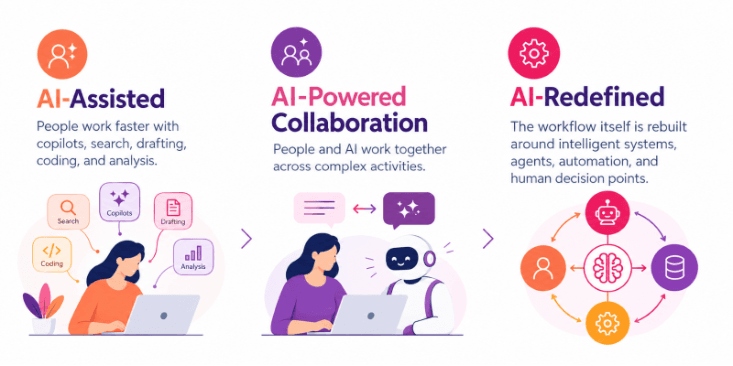
The third stage is where the real opportunity lies. The question is not "Where can we add AI?" It is "If we were designing this workflow today, knowing what AI can do, would we design it the same way?"
What Platform Thinking Must Actually Do?
When I think about a platform that compounds rather than accumulates, I start with four requirements that go beyond the models it hosts.
Reusable Capabilities Instead of One-Off Builds
First, it must create reusable capabilities. The value of a platform is that the next problem never starts from zero. Instead of building every application, integration, AI use case, and workflow independently, organizations create reusable capabilities for data and knowledge access, AI orchestration, domain-specific reasoning, identity and security, regulatory controls, workflow automation, observability, and human review.
The Enterprise Knowledge Layer That Connects the Episodes
Second, it must know the whole story, not the parts. A clinical trial ecosystem involves trial management, data capture, site monitoring, safety reporting, regulatory systems, and countless other applications — each capturing part of the story. Point-to-point integrations can take years, and interoperability alone is not enough. The bigger opportunity is an enterprise knowledge layer that understands how those pieces relate.
Think of it like a season of a television series: each application holds an episode, and the AI-native platform needs to understand the whole story. That requires domain ontologies, lineage, provenance, contextual knowledge, and intelligent orchestration.
Governance as Architecture
Third, it must embed governance as architecture, not approval. Life sciences cannot adopt the mindset of "move fast and break things." You cannot A/B test human life.
AI can accelerate protocol development, research, documentation, analysis, and decision support, but acceleration cannot come at the expense of traceability or accountability. For regulated workflows, principles such as 21 CFR Part 11, ALCOA+, data lineage, provenance, validation, auditability, and human oversight must be part of the architecture — not an approval step added at the end.
The objective is not to remove humans from critical decisions. It is to give them better intelligence, better context, and more time to exercise judgment.
Smaller Teams, Closer to the Problem
Fourth, it must change how teams build. Traditional engineering often moves through a chain: requirements, architecture, design, development, testing, deployment — with different teams owning different stages, information moving through handoffs, and time-to-value expanding.
AI changes the role of the engineer. Instead of building what was requested, engineers work alongside customers to understand the business problem, use AI to accelerate execution, and remain accountable for the outcome.
This is the thinking behind forward deployed engineering. The team becomes smaller, more capable, and closer to the problem. Not "Here is the software we built." But "Here is the outcome we helped you achieve."
What Comes Next?
The long-term vision goes beyond humans interacting with AI — it is systems communicating with systems. A trial platform understands the study, a knowledge system understands the evidence, an AI agent coordinates the workflow, and a regulatory system validates the controls, while another system executes the next action. Humans remain where judgment matters most. That is the direction of an AI-native enterprise.
The next generation of life sciences technology will not be defined by who uses the most AI. It will be defined by who builds the strongest foundation for AI to operate across the enterprise. AI-native platform engineering brings intelligence, data, domain knowledge, automation, cloud technology, security, and human judgment into one reusable foundation.
The future is not about adding AI to yesterday's architecture. It is about building the architecture for what comes next.